Home › Scam of the Week
Scam of the Week: the grandchild phone call that sounds just like them
Your phone rings. A scared voice says, “Grandma, it's me. I'm in trouble. Please send money.” It sounds exactly like your grandchild. It might not be.
Print-friendly. This page prints on plain paper in large type, with the colors and menus removed.
The button needs your browser to allow it. You can also press Ctrl and P together (on a Mac, Command and P).
What is going on
- This is called a family emergency scam, or a “grandparent scam.” A scammer pretends to be a grandchild or other relative who needs money fast.
- The U.S. Federal Trade Commission (FTC) warns that scammers can use AI to clone a voice. It says they may need only a short audio clip of your family member's voice, such as something posted online, plus a voice-cloning program.
- The U.S. Federal Communications Commission (FCC) says callers may also “spoof” Caller ID, so the call can look like it comes from someone you trust.
Warning signs
- The caller says it is urgent and that only you can help.
- The caller says to keep it a secret. The FCC notes the scammer may say “please don't let mom and dad know.”
- Someone else may come on the line pretending to be a lawyer, a police officer, or a court official.
- You are told to pay by wire transfer, cryptocurrency, a payment app, or gift cards. The FTC says these are ways that make it hard to get your money back.
- The FCC says some scammers even ask to meet you in person to collect money. That is a red flag too.
What to do: 3 steps
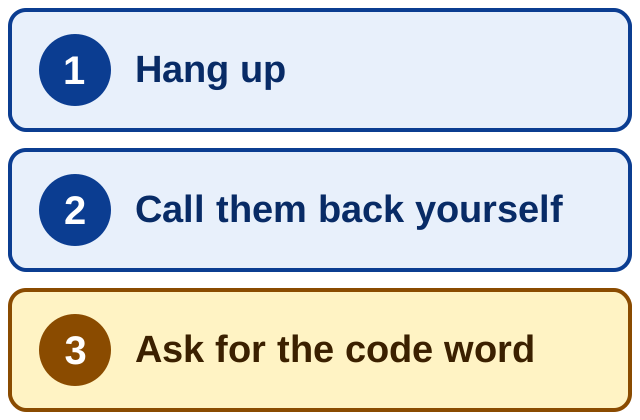
- Hang up. It is not rude. You can say, “I'll call you right back.” Do not trust the voice, even if it sounds just like them.
- Call them back yourself. Use the number saved in your phone for them. Do not call back the number that just called you.
- If you cannot reach them, call someone else in the family or a friend. Do this even if the caller told you to keep it secret.
Can you not hang up yet? The FTC suggests asking a question only the real person could answer, such as “What kind of dog do you have?” or “Where did you spend Thanksgiving last year?”
Family code word tip
The FCC suggests picking a “safe word” that only you and your family know, chosen ahead of time. If the caller cannot say it, it may be a scammer. Here is how to set one up:
- Gather your family, or call each person, this week.
- Choose a word or short phrase together. Pick something people could not guess, and not a name or date that is on social media.
- Do not post it online or text it in the open. Tell it in person or on a phone call.
- Write it on a card and keep the card in a safe place at home.
- Agree on the rule: if someone calls in an emergency and asks for money, ask for the code word first.
If you already sent money
- Call your bank, card company, or payment app right away, using the number on your card or statement. The FTC says the sooner you act, the better.
- Report it at ReportFraud.ftc.gov (opens in a new tab). The FTC also says to report to your state attorney general.
- Tell someone you trust. This can happen to anyone. It is not your fault.
Official sources (we checked each one)
- FTC: Scammers Use Fake Emergencies To Steal Your Money (opens in a new tab)
- FTC Consumer Alert: Scammers use AI to enhance their family emergency schemes (opens in a new tab)
- FCC: ‘Grandparent’ Scams Get More Sophisticated (opens in a new tab)
- FCC: Deep-Fake Audio and Video Links Make Robocalls and Scam Texts Harder to Spot (opens in a new tab)
- ReportFraud.ftc.gov (opens in a new tab), where you can report fraud to the FTC
More help: our Stay Safe page.
From AI Made Simple (ai-made-simple-rust.vercel.app). General information only. Last checked October 21, 2026.